

9 min readStephen Robinson
The AI Subsidy: What Your Subscription Actually Costs to Run
- AI Economics
- Vendor Risk
- Compliance
- AI Adoption
What a $200 plan really consumes, why the gap exists, and what a small regulated practice should do about it before the price finds its floor.
Nobody is seriously arguing about whether $20 a month for AI is worth it anymore. The more useful question is why it costs $20 at all, and what happens when it stops.
The answer is not that inference got cheap. It's that somebody else is covering the difference, and over the past six weeks we've gotten an unusually clear look at both who is covering it and how much they're covering.
Part 1: Who's covering the difference
On July 26, the Wall Street Journal reported that Nvidia is in talks to guarantee roughly $250 billion in debt so OpenAI can lease a 10-gigawatt data center campus in Piketon, Ohio. A separate negotiation would see Nvidia help finance up to $350 billion in chips for the same site. Total campus cost runs north of $500 billion, built on a decommissioned uranium enrichment facility.
The structural detail is the interesting part. The developer is SB Energy, a SoftBank subsidiary. OpenAI would be the tenant. The guarantee exists because OpenAI does not carry an investment-grade credit rating, so the debt gets raised against Nvidia's balance sheet instead of its tenant's. If OpenAI can't make the lease payments, Nvidia covers them and OpenAI keeps the building.
So the chip supplier guarantees the debt of the customer buying the chips, finances the chips themselves, and backstops the building the chips sit in. Critics have called the structure circular. That isn't a slur; it's an accurate description of the cash flow.
Important caveat: as of this writing, terms are unsettled and the arrangement could still collapse. It is a signal about how this infrastructure gets funded, not a completed transaction.
Part 2: How big the gap actually is
Financing structure tells you the buildings are subsidized. It doesn't tell you what your seat costs.
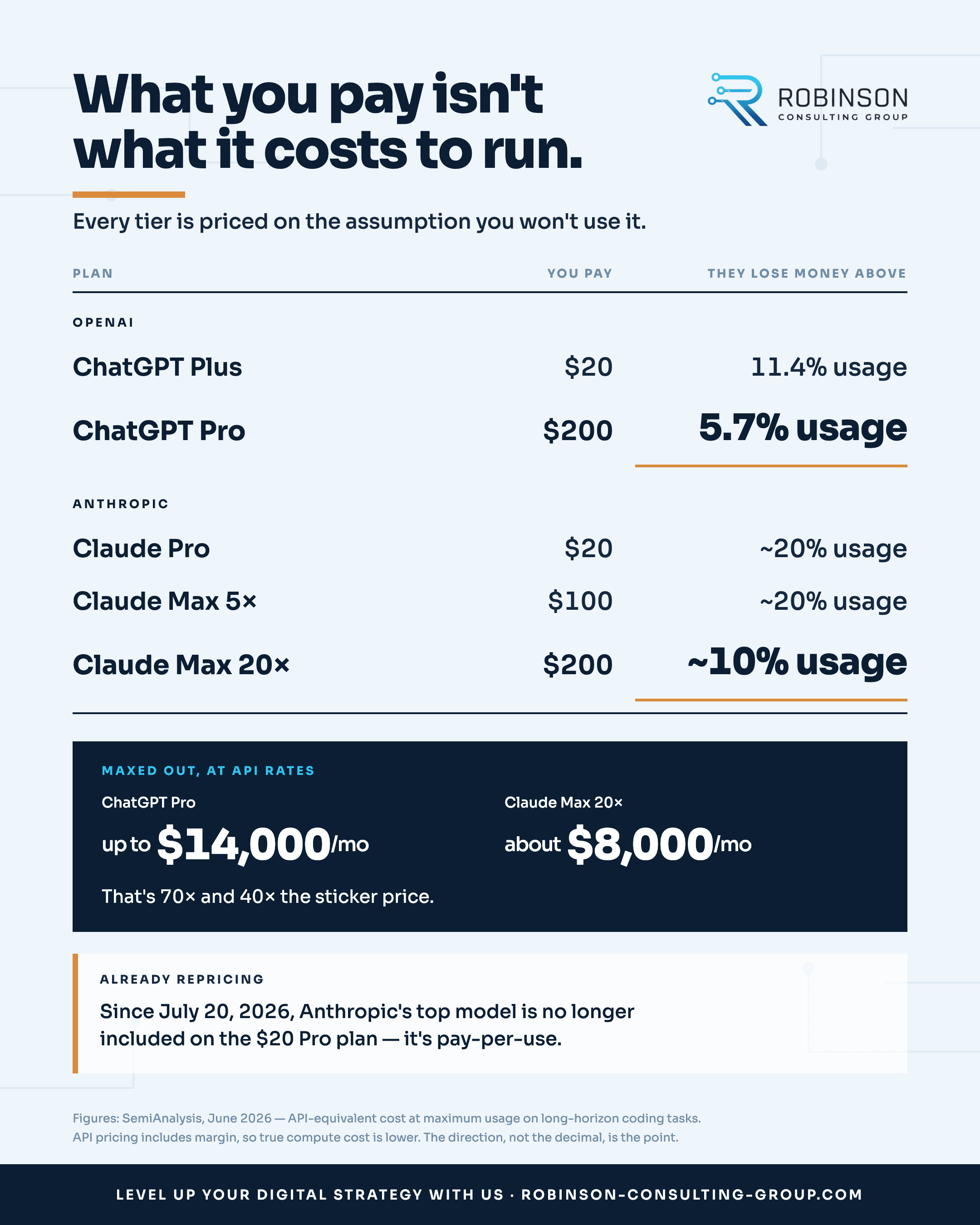
For that, the research firm SemiAnalysis ran a direct experiment, published June 10, 2026: they purchased one of every ChatGPT and Claude subscription plan and ran long-horizon coding tasks until each plan's weekly limit cut them off. Then they priced that consumption at the providers' own published API rates.
| Plan | You pay | Cost at API rates, maxed | Multiple |
|---|---|---|---|
| ChatGPT Pro | $200 / month | up to $14,000 / month | up to 70× |
| Claude Max 20× | $200 / month | about $8,000 / month | about 40× |
Those maxed-out dollar figures were published for the $200 tiers only. The more complete picture is the utilization threshold, the point at which each plan stops making money, because that one is published across the entire ladder:
| Plan | Price | Margin hits zero above |
|---|---|---|
| ChatGPT Plus | $20 | 11.4% utilization |
| ChatGPT Pro | $200 | 5.7% utilization |
| Claude Pro | $20 | ~20% utilization |
| Claude Max 5× | $100 | ~20% utilization |
| Claude Max 20× | $200 | ~10% utilization |
Note the ladders aren't symmetrical. Anthropic sells a $100 middle tier; OpenAI's individual lineup goes Free, Go ($8), Plus ($20), Pro ($200), with no $100 option in between.
Read the right-hand column top to bottom and the pattern is the interesting part: the ceiling gets lower as the plan gets more expensive. For both vendors, the $200 tier tolerates almost exactly half the utilization of the $20 tier before the economics invert: 11.4% down to 5.7% at OpenAI, roughly 20% down to 10% at Anthropic.
You are not being rewarded for upgrading. You are being trusted not to use what you bought.
What that means in plain terms: these plans are priced on the assumption that the overwhelming majority of subscribers will never come close to using them. Light users fund heavy ones. That is not a scandal; it's how gyms, buffets, and insurance all work. It only matters because of what it implies about durability.
The caveat that matters
These are API-equivalent figures, not the providers' true infrastructure cost. API pricing carries margin, so the real cost of serving that compute is meaningfully lower than $14,000 or $8,000. Anyone citing those numbers as "what it costs OpenAI" is overstating the case.
We'd also flag that we were unable to retrieve SemiAnalysis's original report directly; the figures here come from secondary coverage in TechSpot and Cybernews, both citing the same underlying research.
The direction, though, is not in dispute, and the direction is the whole argument. You do not need the decimal to be right to act on this.
Part 3: It's already repricing
The strongest evidence isn't a projection. It's a dated policy change that has already taken effect.
On July 20, 2026, Anthropic changed how its most capable model is distributed across subscription tiers:
- Max and Team Premium: included, capped at 50% of weekly usage limits, with pay-as-you-go credits beyond that
- Pro and Team Standard: not included. Access is pay-as-you-go usage credits only, after a one-time transition credit
- Free: not available at all
Once the transition credit is spent, a Pro subscriber pays standard API rates: $10 per million input tokens and $50 per million output tokens.
This is not a price increase, and framing it as one misses what happened. It's a shift from all-you-can-eat to metered at the frontier tier, while the flat-rate plan continues to exist for everything below it. That is precisely what you would expect to see if the subsidy were beginning to unwind at the top and holding at the bottom, and it is the pattern worth watching, because it will keep going.
What this means for a small practice
Here is where most commentary stops, and where it gets relevant if you run a regulated practice.
The obvious read is "prices will go up, budget accordingly." That's true and it's the least important implication.
A repricing is a budget problem. Disappearance is a compliance problem.
If your intake summaries, client notes, session documentation, or case files live inside a single vendor, and that vendor consolidates, gets acquired, restructures its tiers, or shuts down, your retention obligations do not fold with it. HIPAA. IRS Circular 230. ABA Model Rule 1.6. GLBA. The duty to produce records on request stays with you, regardless of what happened to the company holding them.
A vendor operating on subsidized economics is, by definition, operating on economics that have to change eventually. That doesn't make the tool a bad choice. It makes vendor continuity a question you should have already answered rather than one you discover during an audit.
The question was never "is this tool any good." It's "can I get my data out on a Tuesday with no notice, and would I still be compliant on Wednesday?" Most practices have never tested that.
What to do this quarter
Four things, in order:
- Run an export test on every AI tool that touches client data. Not a review of the vendor's documentation: an actual export. Confirm the file comes out, confirm it's readable without the vendor's software, and confirm it contains what you'd need to satisfy a records request. Put the result in writing.
- Document what one repeatable workflow actually saves you, in hours. Pick the workflow you'd miss most. Measure it. That number is your budget ceiling when pricing changes. Without it, you'll be renegotiating on vibes.
- Read your tier's terms for what's included versus metered. The Anthropic change is the template, not the exception. Know which of your tools have a metered tier above the flat one, and know what triggers the crossover.
- Build the workflow now, while capability-per-dollar is historically high. The institutional learning is the durable asset here, not the subscription. A practice that has spent a year building documented AI workflows is in a materially different position from one that starts in eighteen months at metered rates.
The practices that get hurt by the reprice won't be the ones paying the most. They'll be the ones who never built anything worth paying for, and who onboard late at the higher price with none of the experience.
The subsidy is real, it's large, and it's beginning to unwind at the top. That's not an argument for backing away from AI. It's an argument for being deliberate with a window that is demonstrably not permanent.
Sources
Nvidia / OpenAI Piketon financing: original reporting Wall Street Journal, July 26, 2026. Terms unsettled; deal not finalized as of publication.
- CNBC: Nvidia and OpenAI in talks for up to $250 billion backstop
- Tom's Hardware: Nvidia weighs $250 billion guarantee for SoftBank's 10-gigawatt Ohio campus
- Al Jazeera: Nvidia plans $250bn push to bolster OpenAI's infrastructure ambitions
- Digitimes: Nvidia weighs US$250B backstop for OpenAI's Ohio data center
Subscription economics: SemiAnalysis, published June 10, 2026. Methodology: purchased one of each Anthropic/OpenAI plan; ran long-horizon coding tasks until weekly limits were exhausted; priced consumption at published API rates. Primary report not directly retrieved; figures via:
- TechSpot: A $200 subscription could cost OpenAI $14,000 if fully used
- Cybernews: ChatGPT and Claude usage costs
Model access by plan tier: primary source, effective July 20, 2026.
Robinson Consulting Group helps small regulated practices adopt AI without inheriting risk they can't see. Regulatory references above are framing, not legal advice. Consult your own counsel or compliance advisor for your obligations.